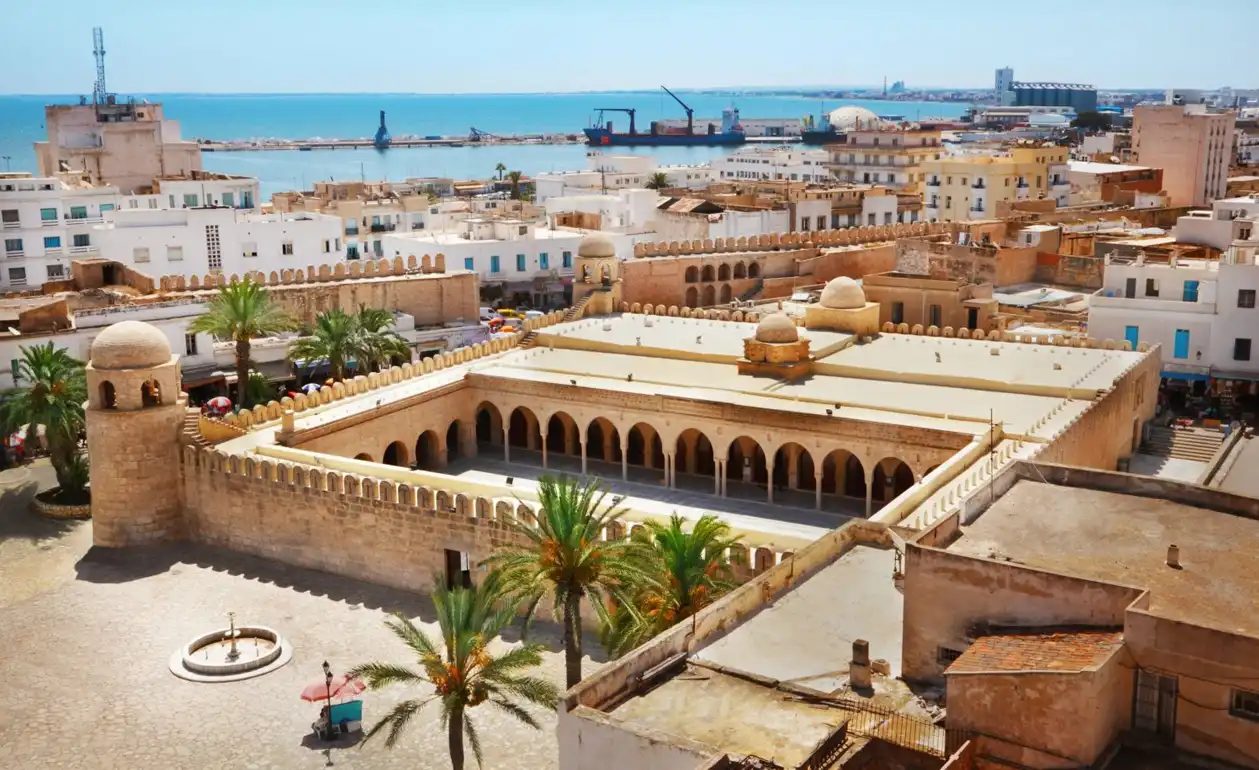
UNESCO Medina of Sousse
9th-century fortified medina listed by UNESCO in 1988. 2.2 km of still-intact ramparts, ribat, Great Mosque, Kasbah, madrasas and thriving souks. The purest preserved Aghlabid medina.
Tunisia's third city (271,000 inhabitants) on the Sahel coast, Sousse combines UNESCO heritage with golden beaches.
Tunisia's third city (271,000 inhabitants) on the Sahel coast, Sousse combines UNESCO heritage with golden beaches. Its fortified 9th-century medina, listed by UNESCO in 1988, houses one of the oldest fortress-mosques in the Maghreb. At its gates lie Port El Kantaoui, Tunisia's premier marina, and 25 km of beaches that make the region the country's leading coastal destination.
Hadrumète (Sousse) was founded around the 9th century BC (between 800 and 750) by Phoenicians from Tyre. It became one of the most important Punic cities after Carthage. In 146 BC, Rome made Hadrumetum a municipality and later a colony under Emperor Trajan. The city prospered under Roman rule: an amphitheatre, forum, baths and mosaic villas attest to its wealth. The Vandals (439) and then the Byzantines (533) dominated it in turn.
The Arab conquest (647) and the founding of nearby Kairouan (670) transformed the region. In the 9th century, under the Aghlabids, Sousse became a military and commercial outport. The ribat (821) and the Great Mosque (851) were built to defend the coast against Byzantine and Sicilian raids. The fortified medina was constructed during this period, forming an exceptional early medieval Islamic architectural ensemble. The Fatimids and then the Hafsids further developed the city.
Under the Ottomans (16th century) and the Husseinites, Sousse remained an important port for olive oil and cereals. French protectorate rule (1881) transformed it into a major phosphate port and railway terminus. Independence (1956) made it a major industrial hub. Coastal tourism took off in the 1970s with the development of Port El Kantaoui (1979), the Maghreb's first integrated resort. The medina was inscribed as a UNESCO World Heritage site in 1988.
8 must-see sites selected by our local team.
9th-century fortified medina listed by UNESCO in 1988. 2.2 km of still-intact ramparts, ribat, Great Mosque, Kasbah, madrasas and thriving souks. The purest preserved Aghlabid medina.
9th-century (821) fortress-monastery: one of the oldest and best-preserved in the Islamic world. Cells for warrior-monks, prayer room, watchtower (Nador) with 360° views.
Built in 851 by the Aghlabid emir Abou'l-Abbas. Austere and fortified architecture typical of early Islam. Arcaded courtyard, prayer hall with 13 aisles, painted ceiling. Without minaret (rare).
Housed in the 11th-century Kasbah. Tunisia's 2nd finest collection of Roman mosaics after the Bardo. Medusa's Head, Triumph of Bacchus, spectacular marine mosaics.
5 km of Palaeochristian underground galleries (2nd–4th century) containing 15,000 tombs. Part is open to the public.
Maghreb's first integrated marina (1979) 10 km north. Marina with 340 berths, 27-hole golf course, 5* hotels, waterfront restaurants, Hannibal Park amusement park.
5 km of fine sand in the heart of the hotel zone. Shallow waters, sun loungers, banana boats, jet-skis. Lively promenade in the evening.
Main souk of the medina, perfumers, jewellers, herbalists. Remarkable vaulted roof from the 13th century.
A journey through the ages that shaped Sousse.
Built by the emir Ziadet Allah I, it forms part of a chain of coastal fortresses designed to defend Ifriqiya from Byzantine incursions from Sicily. Austere architecture typical of early Islam: 38 monastic cells for the murabitoun (warriors of faith), prayer hall, watchtower (Nador) 27 m high. A model of its kind, considered one of the best preserved in the Islamic world.
Built by the emir Abou'l-Abbas Mohamed, it reflects 9th-century military architecture: façade of bare stone pierced with loopholes, rectangular courtyard, prayer hall with 13 naves perpendicular to the qibla wall. Distinctive feature: no minaret, replaced by corner towers used for the call to prayer.
Citadel overlooking the medina, housing the Khalef El Fata tower (859), one of the world's oldest lighthouses. Now an archaeological museum displaying Roman mosaics from Sousse, El Jem and Thysdrus.
Vast Palaeochristian necropolises testifying to the importance of Hadrumetum's Christian community under the Roman Empire. 5 km of galleries, 240 chambers, 15,000 tombs. Several frescoes and funerary inscriptions in Latin and Greek.
2.2 km of dressed stone ramparts, punctuated by watchtowers and monumental gates (Bab El Bhar, Bab El Khabli, Bab El Gharbi). They define the original Aghlabid medina, practically intact.
Tunisia's oldest popular festival. Colourful carnival, float parades, folk dances, beauty contests in the medina.
International symphonic concerts in the UNESCO Roman amphitheatre at El Jem (60 km). Exceptional acoustics.
Private car: 3 hours via motorway A1 (230 km, toll 8 DT). SNTRI bus: 4 hours, 25 DT, several departures daily from Houmt Souk. Indirect flight via Tunis: not practical. Train from Tunis: 2 hours, 12 DT.
Sahel light metro (Sahel Metro) connecting Sousse–Monastir–Mahdia (5 DT, 1 hour). Numerous and inexpensive taxis (metered). Carriages in the medina for sightseeing.
Sousse: best compromise culture (UNESCO medina) + beach. Hammamet: more upscale and calm, Cap Bon. Djerba: unique island, more authentic. Sousse for 4-5 days culture-beach, Hammamet for relaxation, Djerba for complete experience.
3-4 days are enough: 1 day medina + ribat + museum, 1 day beach + El Kantaoui, 1 day excursion to El Jem or Kairouan, 1 optional day Monastir/Mahdia or relaxation.
Yes, especially at Port El Kantaoui (bars, casinos, clubs until 3am). Sousse town more moderate: terraces on Boujaâfar, fish restaurants. The medina closes early (10pm).
Boujaâfar decent but busy. Prettier beaches: El Kantaoui (private hotel beaches), Hergla (20 km north, unspoilt), Monastir Skanes.
El Jem (60 km, UNESCO amphitheatre), Kairouan (60 km, UNESCO holy city), Monastir (25 km, ribat + Bourguiba), Mahdia (60 km, medieval port). Tunis-Carthage by bus 2.5 hours.
Our local team designs your ideal Sousse programme. Private car or group place, the cheapest on the market.