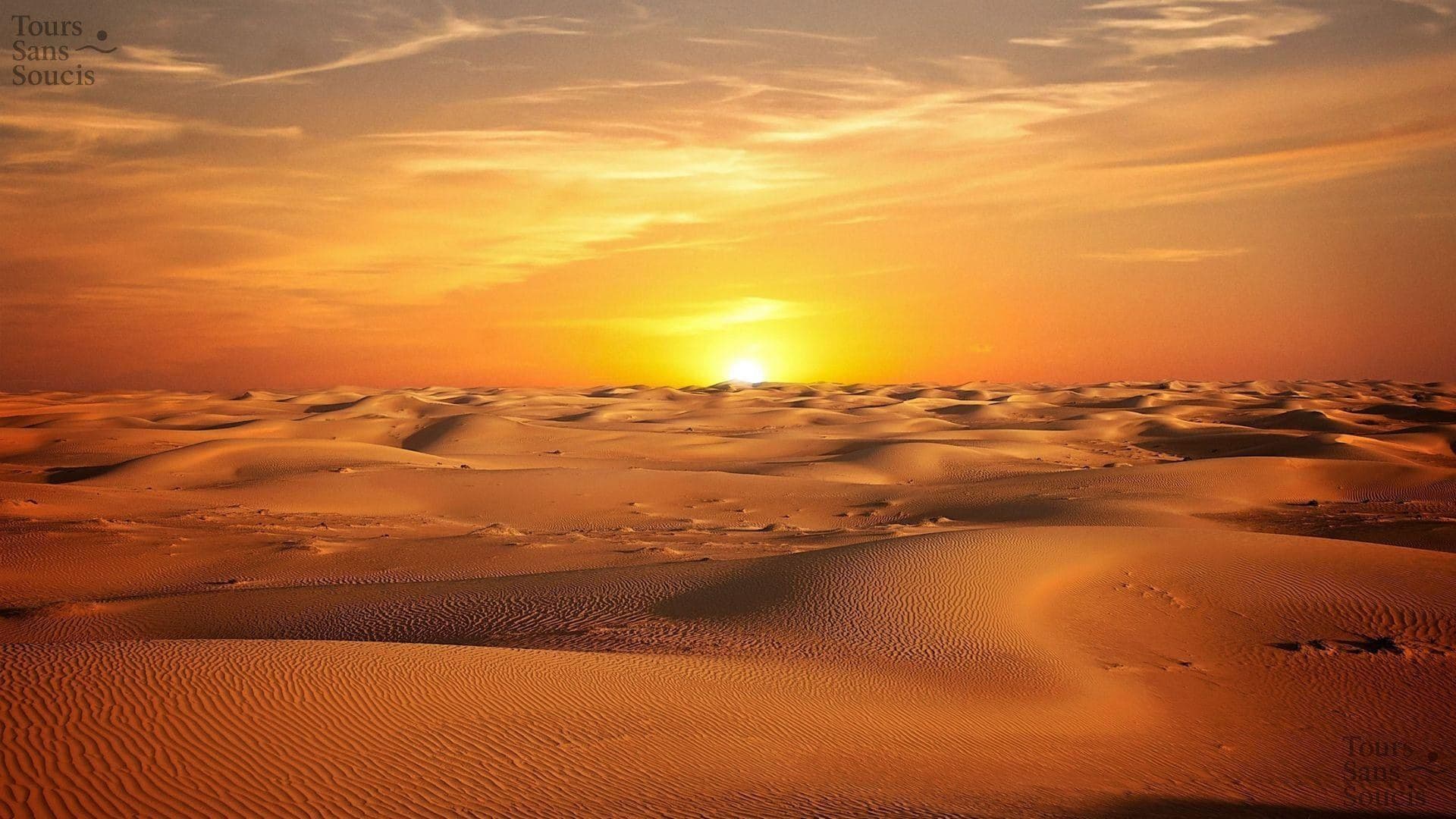
Ksar Ghilane: the oasis and its hot spring at the gates of the Grand Erg
A palm grove set on the edge of an ocean of dunes, a pool of hot water where you swim in the middle of the sand, a forgotten Roman fort on a hillock: Ksar Ghilane is the first real encounter with the Sahara from Djerba.

- From Djerba
- ≈ 240 km
- Driving time
- 3 h 30 – 4 h
- Suggested time
- 1 day or 1 night
- Best season
- October → May
On the edge of the Grand Erg Oriental, where the stony tracks of the Dahar suddenly give way to sand, the oasis of Ksar Ghilane is the number-one desert destination from Djerba. People come for one image: a palm grove, a pool of hot water and, just behind it, the first great dunes rolling out to the Algerian horizon.
Why Ksar Ghilane
- The hot spring: lukewarm water (around 29 °C) gushes up in the heart of the palm grove and fills a pool where you can swim facing the dunes. It is the most unusual experience in the Tunisian South, enjoyed in every season.
- The dunes: Ksar Ghilane marks the start of the largest dune field in the Sahara. On foot, by camel or by quad bike, you climb the first ridge and sand becomes king.
- The Roman fort of Tisavar: a few kilometres out in the dunes, the ruins of a garrison fort from the 2nd century, an outpost of the Roman limes. You reach it by quad bike, by camel, or on foot for the most determined.
- The night under the stars: far from any light, the sky of Ksar Ghilane is one of the purest in Tunisia. This is where our bivouac nights take place.
A little history
The name comes from the ksar, the fortified granary found throughout the South, and from the Ghilane tribe. Long before, the Romans had set up the fort of Tisavar here to watch over the Saharan frontier of the Empire: Ksar Ghilane was already a strategic water point on the caravan route between the coast and the deep desert. Today, the oasis lives from tourism and its camps, run by formerly nomadic families who have settled.
How the visit works
For a day trip, the outing via Matmata goes first to the oasis: a swim in the spring, the dunes, lunch, then the troglodyte houses of Matmata and the Berber villages of Tamezret and Toujane, with a return to Djerba in the late afternoon. The outing via Tataouine and Chenini leaves early in the morning: Ksar Hadada, the ksour of Tataouine and the hilltop village of Chenini, then the oasis, its hot spring and its dunes, lunch included, with a return to Djerba in the late afternoon (about 10 hours out). A camel ride or quad bike is optional, on site. On the 2-day option, the evening is spent at the camp: dinner and a night in a tent under a starry sky, before hitting the road again.
Practical information
- From Djerba: about 240 km, 3 h 30 to 4 h on the road including stops.
- Best season: October to May. Summer is very hot (over 40 °C); winter nights are cold in a tent, so bring a fleece.
- What to bring: swimsuit, towel, hat, sunglasses, sunscreen, closed shoes for the dunes and the fort.
- On site: quad bike and camel rental, cafés, small craft shops.
Our advice
If you only have one day, choose the version via Tataouine and Chenini: the road is more spectacular and you see a hilltop Berber village before the dunes. The version via Matmata, for its part, adds the troglodyte houses and the villages of Tamezret and Toujane. If you can sleep on site, do so: the evening and early morning on the dunes, without the day visitors, are the two most beautiful moments in Ksar Ghilane.