Prehistory and Berber settlement
4000 - VIIIth century BCDjerba has been inhabited since the late Neolithic (4000 BC), as evidenced by surface sites scattered across the island. The first inhabitants were Berber populations — the Getules according to ancient sources — pastors and farmers who exploited the island's lands, which were then more humid than today. Indigenous material culture left few traces, overshadowed by successive colonial waves.
Key takeaways
- Continuous Berber settlement since 4000 BC
- Tribe of the Getules according to Roman sources
- Very few archaeological remains predating the Phoenicians
Detailed chronology
Late Neolithic
Scattered Neolithic sites. Berber populations (ancient Getules) settled in agriculture and livestock farming. The island was then more heavily watered.
Bronze Age and Early Iron Age
Very few remains. Berber population organised in clans. Probable early contacts with Phoenician sailors from the 12th century BC onwards.
Phoenician and Punic period
VIIIth century - 146 BCThe Phoenicians founded Meninx (today Henchir Meninx, near Boughrara) in the 8th century BC as a stopover between Carthage and Egypt. The city flourished thanks to the purple dye extracted from murex (bolinus brandaris) abundant in the Boughrara lagoon. According to Homer (Odyssey, Book IX), Djerba would be the island of the Lotophages, where Ulysses landed and where his companions tasted the lotus that made them forget their homeland. Local Jewish tradition traces the arrival of Jews to 586 BC, following the destruction of the First Temple by Nebuchadnezzar II.
Key takeaways
- Meninx founded in the 8th century BC by the Phoenicians
- Murex purple industry (the finest in the world according to Pliny)
- Jewish tradition: arrival in 586 BC after destruction of the First Temple
- Island of the Lotophages according to Homer's Odyssey
Detailed chronology
Foundation of Meninx
Phoenician trading post established on the southern coast of the island, near the Boughrara lagoon. The site is today at Henchir Meninx (Hara Seghira municipality). Phoenician population mixed with the local Berber population ('Liby-Phoenicians').
Purple industry
Meninx develops a purple industry extracted from murex in the lagoon. This purple, intended to dye imperial garments, will become the island's specialty for 1000 years. Mentioned by Pliny the Elder as 'the finest purple in the world'.
Traditional arrival of the Jewish community
According to Djerbian Jewish oral tradition, priests and Levites fleeing the destruction of the First Temple of Jerusalem by Nebuchadnezzar II are said to have brought a door of the Temple to Djerba. This founding stone is believed to be the origin of the La Ghriba synagogue in Hara Seghira. A tradition not archaeologically confirmed but testifying to the antiquity claimed by the community.
Punic period under Carthage
Meninx becomes a city dependent on Carthage. Punic stelae. Possible tophet (unconfirmed). The inhabitants are 'Libyphoenicians', a Punico-Berber mix. Punic coin striking from the 4th century BC onwards.
Punic Wars
Djerba remains loyal to Carthage during the three Punic Wars. After the fall of Carthage in 146 BC, Meninx falls into the Roman sphere.
Roman period
146 BC - 439 AD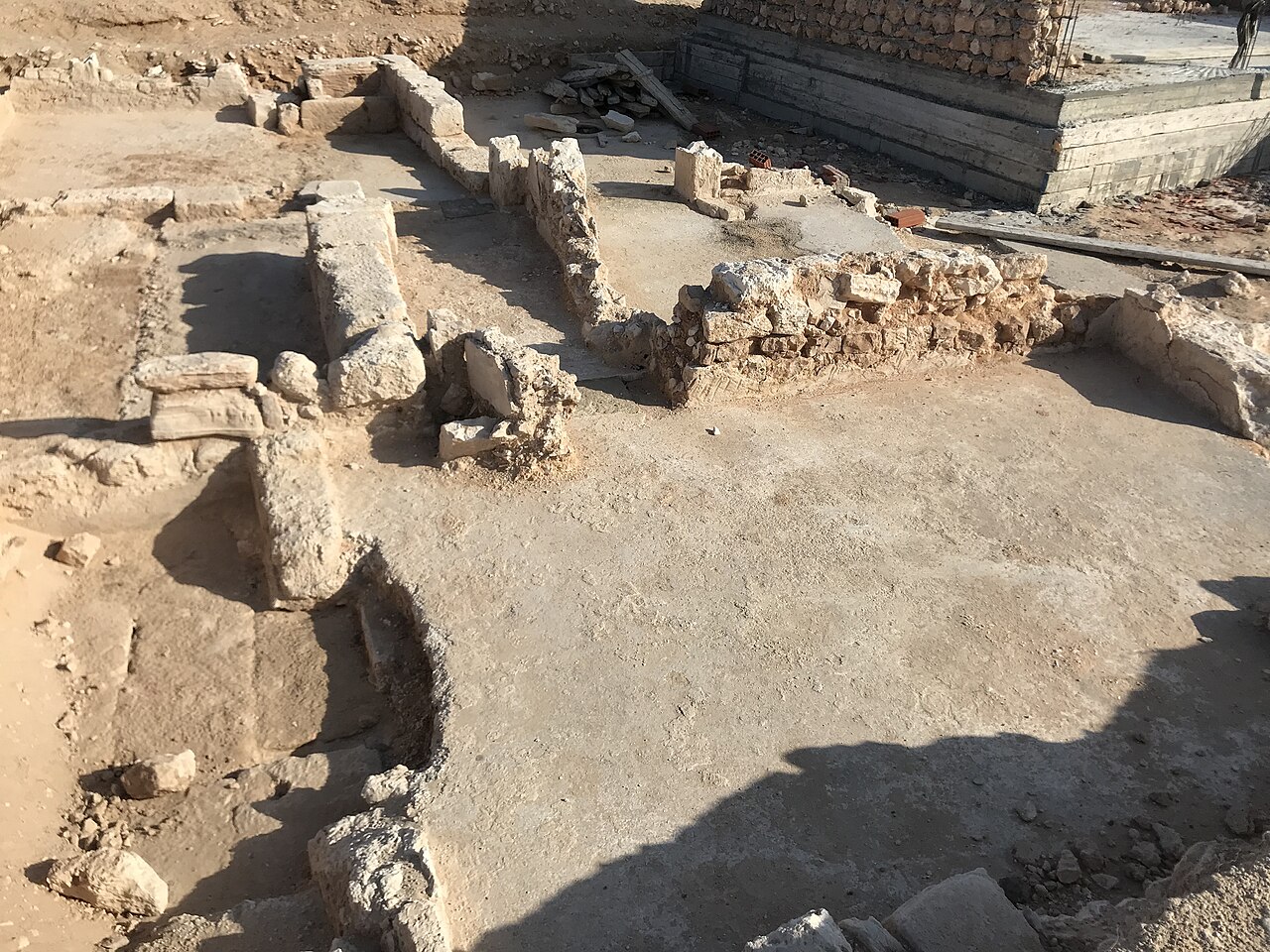
Under Rome, Meninx reached its apogee and became one of the most prosperous cities in Africa. Purple, garum (fish sauce) and olive oil were exported throughout the Empire. In the 2nd century AD, Emperor Trajan had the Roman road built connecting Djerba to the mainland (Trajan's Bridge, still visible in calm weather near El Kantara). The island then had several important cities: Meninx, Tipasa Maior (near Bourgou), Girba (Houmt Souk).
Key takeaways
- Meninx, one of the most prosperous cities of Roman Africa
- Purple, garum and olive oil industry
- Trajan's Roman road (2nd century) — still visible at El Kantara
- Christianisation in the 3rd century (basilicas)
Detailed chronology
Battle of Thapsus and conquest of Djerba
Julius Caesar defeated the Pompeians at Thapsus. Tunisia becomes a Roman province. Djerba (Meninx) is integrated into the province of Africa Proconsularis.
Roman apogee of Meninx
Meninx prospered thanks to purple, garum, and olive oil. Construction of monuments: forum, temples, baths, theatre. Exceptional mosaics. Population estimated at 25,000 - 35,000 inhabitants. The Roman city extended over 100 hectares (larger than Carthage at certain times).
Trajan's Roman road
Construction under Emperor Trajan of a submersible road of 7 km connecting Djerba (El Kantara, 'the bridge' in Arabic) to the mainland at Jorf. This engineering feat is still visible in calm weather at low tide. Rebuilt several times, it allowed uninterrupted trade for 1500 years.
Christianisation
Christianity spreads rapidly across Djerba. Several Christian basilicas are built (ruins still visible at Henchir el-Hattaya). The island has several bishops at the Councils of Carthage.
First decline
Economic crisis and political instability. Murex dye begins to lose its value. Vandal invasions approach.
Fall of Carthage to the Vandals
The Vandals conquer North Africa. Meninx loses its status. Progressive decline of the ancient city. The remains will be buried under sand for centuries.
Vandal and Byzantine period
439 - 647Under the Vandals (439-533) and then the Byzantines (533-647), Djerba undergoes economic and demographic decline. Meninx gradually loses its population. Christianity persists but communities become isolated. Justinian has Byzantine fortifications built, some remains of which still stand at Tipasa Maior and Girba.
Key takeaways
- Decline of Meninx and the island's economy
- Byzantine fortifications at Bourgou (Tipasa Maior) and Girba
- Persistent coexistence of Jewish and Christian communities
Detailed chronology
Vandal period
Vandal Kingdom of Africa. Arian persecutions against Nicene Christians. Declining economy. Meninx never regains its Roman heyday.
Byzantine reconquest and fortifications
Belisarius, general of Justinian, reconquers Africa for Byzantium in 533. Fortification of Djerba against raids by Saharan nomads. Byzantine remains at Bourgou (Tipasa Maior) and Houmt Souk.
Persistence of religious communities
Jewish and Christian communities coexist. Probable reconstruction of the La Ghriba synagogue. Several Christian basilicas restored.
Arab conquest and Ibadism
647 - 1135The Arab conquest transforms Djerba profoundly. The Berbers of the island adopt Islam but embrace the Ibadite current (moderate Kharijism), a minority movement advocating equality among believers and rejection of hereditary caliphate. Ibadism deeply imprints Djerbian society: architecture of fortified mosques, tribal organisation, traditions of hospitality, historic refusal of persecution against minorities. The island becomes a refuge for persecuted communities (Jewish, Christian, Ibadite Kharijite).
Key takeaways
- Adoption of Ibadism: Djerba becomes one of the last bastions in the world
- Tradition of hospitality towards Jewish and Christian minorities
- Over 200 fortified mosques built (unique vernacular architecture)
- Millennial hydraulic system and palm groves
Detailed chronology
Arab conquest
Arab armies commanded by Abdallah ibn Sa'd ibn Abi Sarh (governor of Egypt) cross Tunisia. Djerba is conquered without major resistance. The Berber population gradually adopts Islam.
Adoption of Ibadism
The Berbers of Djerba adopt the Ibadite Kharijite current (minority Muslim rite). This doctrine, more tolerant and egalitarian, deeply marks Djerbian culture. Ibadism advocates strict religious observance, rejection of the Umayyad and Abbasid caliphate, and rule by the 'best'. Even today, Djerba (alongside the Algerian Mzab and Oman) remains one of the last Ibadite bastions in the world.
Construction of Ibadite fortified mosques
Over 200 mosques are built, many of them fortified: the Fadhloun mosque (14th century, whitewashed, buried cistern), the underground mosque of Guellala. Austere architecture, without decoration, expressing Ibadite puritanism.
Refuge for Jewish minorities
Djerbian tradition of hospitality towards Jewish communities. La Ghriba synagogue at Hara Seghira rebuilt. Prosperous Jewish community organised around two villages: Hara Kbira and Hara Seghira.
Fatimid and Zirid period
Djerba nominally depends on the Fatimids and then the Zirids. But retains de facto great autonomy. Ibadites continue their specific religious life.
Hilalian invasion
The Banu Hilal invade Ifriqiya. Djerba, an isolated island, is less affected than mainland cities (Kairouan destroyed). Increased refuge status.
Hydraulic system and palm groves
Development of an ingenious irrigation system: cisterns ('majen'), foggara (underground galleries), palm groves. The population reaches 50,000 inhabitants. The island produces olive oil, dates, pottery and textiles.
Norman and Aragonese occupations
1135 - 1432During the 12th-14th centuries, Djerba undergoes several Christian occupations: Normans from Sicily, then Aragonese and Sicilians. The people of Djerba resist courageously and eventually reclaim their island. Roger of Lluria, Aragonese admiral, has the first fortress built at Houmt Souk (the future Borj El Ghazi Mustapha). It is also during this period that the main architectural and urban characteristics of the island become established.
Key takeaways
- Norman conquest by Roger II (1135)
- Roger of Lluria builds Borj El Ghazi Mustapha (1289)
- Period of Djerbian autonomy under tribal councils
- Djerbien vernacular architecture definitively established
Detailed chronology
Norman conquest by Roger II of Sicily
Roger II, Norman king of Sicily, conquers Djerba as part of the 'Norman Kingdom of Africa'. Brief occupation. Djerbians resist actively.
Recapture by the Almohads
Abd al-Mumin, Almohad caliph, recaptures Djerba from the Normans. Brief period of Maghrebi unity.
Aragonese occupation by Roger de Lluria
Roger de Lluria, admiral of the Kingdom of Aragon, conquers Djerba. Construction of the first fortress at Houmt Souk (which will become Borj El Ghazi Mustapha). The island remains under Christian domination for 26 years.
Construction of Borj El Ghazi Mustapha
Roger de Lluria has the fortress built at Houmt Souk, later enlarged by the Spanish and Ottomans. Strategic position commanding the port.
Hafsid reconquest
Hafsid sultan Abu Yahya Abu Bakr II recaptures Djerba. The Djerbians, tired of occupations, revolt and drive out the Aragonese.
Aragonese attempt
New Aragonese attempt to seize Djerba. Failure. The island remains Hafsid with great local autonomy.
Period of Djerbien autonomy
Djerba governs itself via a council of sheikhs (the Djerbien 'ouled'). The island becomes a centre of resistance and a refuge for pirates and Ibadites.
Spanish, Ottomans and the 1560 massacre
1503 - 1574The 16th century is the age of great confrontations between Spanish (Habsburgs) and Ottomans in the Mediterranean. Djerba, a strategic position, is the stakes of several sieges and battles. In 1560, the island is the theatre of one of Spain's greatest defeats in history: 5,000 Christian soldiers massacred by Dragut. Their skulls piled up formed a macabre pyramid, the 'Borj El Roussian', which persisted until 1848.
Key takeaways
- Massacre of Djerba (31 July 1560): 5,000 Christians killed
- Pyramid of skulls (Borj El Roussian) erected by Dragut, dismantled only in 1848
- Djerba, base of Barbarossa and Ottoman corsairs
- Lepanto (1571): revenge for the humiliation of Djerba
Detailed chronology
First Spanish raid
Pedro Navarro, Spanish admiral, attacks Djerba. Failure against Djerbien resistance.
Massacre of the Spanish
Pedro Navarro launches a new expedition. The Djerbians, with the help of Aroudj Barbarossa (future brother of Khayr al-Din), inflict a severe defeat: 4,000 Spanish killed. First great massacre of Christian forces at Djerba.
Ottoman presence
Khayr al-Din Barbarossa establishes an Ottoman base at Djerba. Centre of Barbary corsairing in the central Mediterranean.
Spanish reconquest
The Spanish, taking advantage of Ottoman dissensions, retake Djerba. Reinforcement of Borj El Ghazi Mustapha. Spanish garrison of several thousand men.
Naval battle and siege of Djerba
Christian coalition (Spain, Holy Roman Empire, Papal States, Venice, Genoa, Florence, Malta) under the command of Don Juan de la Cerda lands at Djerba. Construction of a fort on the El Kantara peninsula. But the Ottoman fleet of Piyale Pacha (84 galleys) arrives, surprising the Christians. Catastrophic naval battle for the Christians: 27 galleys lost, 18 captured.
MASSACRE OF DJERBA
After two months of siege, the Christians entrenched in their fort capitulate. Famine, disease, thirst. Dragut massacres the survivors: 5,000 Spanish, Italian and Maltese soldiers are killed. Their skulls are piled into a macabre pyramid, the 'Borj El Roussian' (Tower of Skulls), erected near the port of Houmt Souk. This pyramid remains for 288 years the symbol of Ottoman victory and remains visible until 1848.
Don Juan of Austria avenges the humiliation at Lepanto
The humiliation of Djerba prompts Spain to organise a counter-strike. The Battle of Lepanto (1571), where Don Juan of Austria crushes the Ottoman fleet, is partly linked to the need to restore the prestige lost at Djerba.
Final Ottoman conquest of Tunisia
Sinan Pacha retakes Tunis from the Spanish. Djerba officially becomes part of the Ottoman Regency of Tunis. End of Christian occupations for 300 years.
Ottoman and Husainid regency
1574 - 1881Under the Ottoman Regency and later the Husainid dynasty (from 1705), Djerba regains a certain prosperity. The island develops its traditional specialities: weaving, Guellala pottery, fishing, dates. Ibadite, Jewish and Christian (increasingly rare) communities coexist. The Ghriba synagogue becomes a major Jewish pilgrimage site. Ottoman fondouks built in the Houmt Souk medina.
Key takeaways
- Semi-autonomous Ottoman Regency (1574-1881)
- Construction of the fondouks of the Houmt Souk medina
- Apogee of the Djerbien Jewish community (7,000 members in the 18th century)
- Dismantling of the Borj El Roussian in 1848 (288 years after the massacre)
Detailed chronology
Ottoman Regency
Djerba integrated into the Regency of Tunis. Light Turkish garrison. Local autonomy preserved. Barbary corsairs use the port of Houmt Souk.
Construction of Ottoman fondouks
Edifice in the Houmt Souk medina of fondouks (caravanserais): Fondouk El Bakri, Fondouk El Berrada, Fondouk El Erbi. These fondouks accommodate merchants and their merchandise. Today transformed into charming hotels.
Construction of the Mosque of Foreigners
In Houmt Souk, a mosque for foreign merchants (non-Djerbians, non-Ibadites). Typical provincial Ottoman architecture: octagonal minaret crowned with a dome.
Heyday of the Jewish community
The Djerbian Jewish community, organised around two villages Hara Kbira ('the Great Hara') and Hara Seghira ('the Small Hara'), reached 7,000 members. The Synagogue of La Ghriba became the religious centre. First documented Lag Ba'omer pilgrimage in the 18th century. Yeshivot (Talmudic schools) of international renown.
Abolition of slavery by Ahmed Bey
The Bey of Tunis Ahmed Bey abolished slavery. This also affected Djerba where slavery was limited.
Dismantling of Borj El Roussian
By order of Bey Ahmed II, the macabre pyramid of skulls erected by Dragut in 1560 is finally dismantled and the skulls buried. A symbolic act of reconciliation. Today, a commemorative plaque recalls this episode near Borj El Ghazi Mustapha.
French protectorate
1881 - 1956The French protectorate slowly modernised Djerba. The Roman causeway of El Kantara was restored and adapted for vehicles. Regular maritime connections were established with Tunis and Marseille. The first French explorers began excavating the ruins of Meninx. The Second World War largely spared the island, but marked the end of massive Djerbian Judaism (aliyah to Israel after 1948).
Key takeaways
- Slow modernisation under the protectorate
- Archaeological excavations at Meninx (Henchir Meninx)
- Beginning of Jewish aliyah to Israel (1948)
- Modernisation of the El Kantara causeway
Detailed chronology
Establishment of the protectorate
Treaty of Bardo. Djerba integrated into the French protectorate of Tunisia. Reinforced French central administration in Houmt Souk.
Archaeological excavations at Meninx
First systematic excavations by French archaeologists at Henchir Meninx. Discovery of exceptional mosaics, now in the Bardo Museum and the Regional Museum of Djerba.
Modernisation
Construction of asphalt roads, Franco-Arab schools, civil hospital. Modernisation of the El Kantara causeway allowing passage of motor vehicles. First European tourists (artists, writers such as Henri de Montherlant).
Second World War
Brief Italian then German occupation (Afrika Korps). Djerba spared from major combat, but some Allied bombing of the port. Liberation in May 1943.
Israeli independence and beginning of aliyah
Creation of the State of Israel. The Djerbian Jewish community, which numbered 7,000 members in the 19th century, began to emigrate massively. By 1956, there were 4,000. By 2026, approximately 1,000.
Independence of Tunisia
Tunisia became independent. Djerba integrated into the Tunisian Republic under the presidency of Habib Bourguiba.
Republic, tourism and UNESCO
1956 - todayDjerba became one of Tunisia's leading tourist destinations following the inauguration of Djerba-Zarzis International Airport in 1970. Over one million visitors annually in the 2010s. The terrorist attack on La Ghriba in 2002 marked a turning point. The artistic project Djerbahood (2014) in Erriadh redefined cultural identity. UNESCO inscription in 2023, the crowning of millennia of history.
Key takeaways
- International airport 1970 — tourism boom
- La Ghriba attack 2002 (21 deaths)
- Djerbahood 2014 — 250 street art murals in Erriadh
- UNESCO INSCRIPTION 2023 — heritage recognition
Detailed chronology
Proclamation of the Republic
Djerba became one of the governorates of the new Tunisian Republic. Habib Bourguiba modernised education and women's rights.
Djerba-Zarzis International Airport
Inauguration of Djerba-Zarzis International Airport (renamed Djerba-Mellita in 2008). Enabled massive arrival of European tourists. Direct flights from Paris, Brussels, Geneva, Frankfurt, Milan.
Tourism boom
Massive construction of hotels on the north-east coast (Sidi Mahrez, Aghir). 35,000 hotel beds by 2000. Djerba became a major Mediterranean coastal destination. The island's economy was transformed.
La Ghriba attack
Suicide attack carried out by Al-Qaeda outside La Ghriba synagogue. 21 deaths, including 14 German tourists, 5 Tunisians and 2 French nationals. Huge shock for the Jewish community and for Djerba's tourist image. Restoration and security reinforcement of the synagogue.
Tunisian Revolution
Djerba participated in the Jasmine Revolution which overthrew Ben Ali. Demonstrations in Houmt Souk.
Djerbahood — artistic project
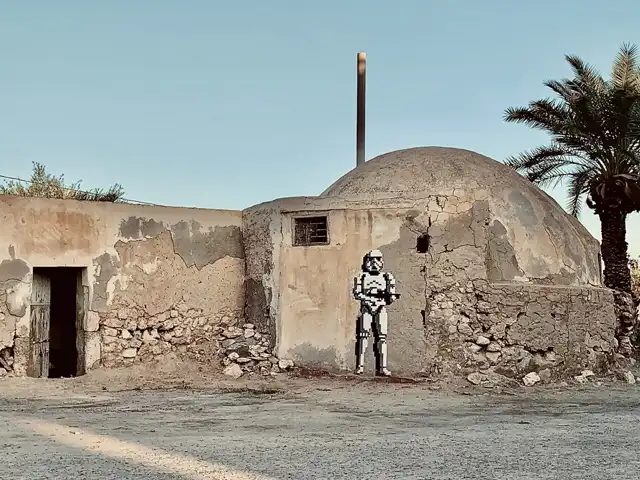
In Erriadh (former Jewish village), Mehdi Ben Cheikh organised Djerbahood: 250 murals by international street artists adorned the whitewashed walls of the village. A project that redefined Djerba's cultural identity as an artistic crossroads.
New attack on La Ghriba
Attentat à la veille du pèlerinage annuel : un agent de la garde nationale tunisienne tue 5 personnes (2 fidèles juifs, 2 gardes nationaux, 1 policier) avant d'être abattu. Le pèlerinage annuel est interrompu pour la première fois depuis le XVIIIe siècle.
INSCRIPTION UNESCO
L'UNESCO inscrit officiellement Djerba au patrimoine mondial sous le titre « Djerba : témoignage d'un mode d'occupation d'un territoire insulaire ». Reconnaissance de l'architecture vernaculaire, des mosquées-forteresses ibadites, de la synagogue de la Ghriba, du système hydraulique millénaire et de la coexistence interreligieuse. Consécration de 3000 ans d'histoire.
Djerba inscrite au patrimoine mondial — 2023
18 septembre 2023 · 45ᵉ session de l'UNESCO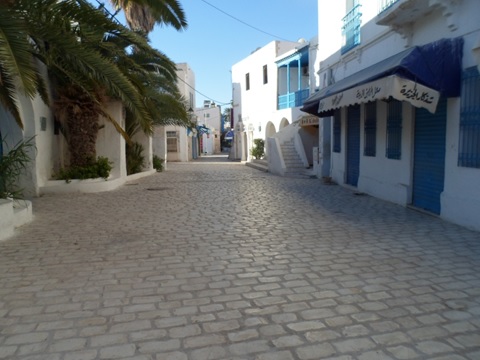
L'inscription UNESCO 2023 « Djerba : témoignage d'un mode d'occupation d'un territoire insulaire » est une propriété en série (serial property) regroupant 24 composantes monumentales et urbaines réparties sur l'île. Elles illustrent l'architecture vernaculaire djerbienne, la coexistence interreligieuse, l'ingéniosité hydraulique et l'organisation spatiale traditionnelle. Le bien couvre une zone de 8 millions m² (zone tampon comprise).
24 monuments classés en 5 catégories
🕌 Mosquées-forteresses ibadites (15 mosquées)
Les mosquées djerbiennes constituent un type architectural unique au monde. Construites entre les XIIe et XIXe siècles, elles allient fonction religieuse, défensive et hydraulique (citernes intégrées). Architecture austère, blanchie à la chaux, sans décoration figurative — expression du puritanisme ibadite.
Mosquée Fadhloun — Mahboubine (centre île) (XIVe siècle)
Mosquée fortifiée la plus emblématique de l'architecture djerbienne. Murs blancs sans décoration, minaret rectangulaire utilisé comme tour de guet, citerne enterrée pour les ablutions, école coranique attenante. Située au cœur de la palmeraie. Cœur spirituel et école coranique pendant des siècles.
Mosquée souterraine de Guellala — Guellala (sud) (XIIIe siècle)
Unique mosquée entièrement creusée dans la roche calcaire de Djerba. Salle de prière souterraine accessible par un escalier. Architecture défensive (refuge en cas de raids des corsaires). Citerne intégrée.
Mosquée Lalla Hadria — Midoun (est) (XVe siècle)
Mosquée fortifiée typique. Trois nefs voûtées, cour à arcades, minaret carré. Bâtie en pierres de taille recouvertes de chaux. Témoigne de la richesse de Midoun à l'époque hafside.
Mosquée Sidi Yati — Sidi Yati (centre) (XIVe siècle)
Sanctuaire d'un saint local éponyme. Coupole blanche caractéristique. Mausolée toujours actif, lieu de pèlerinage local lors du moussem annuel.
Mosquée El Bassi — Houmt Souk (XVIIIe siècle)
Mosquée centrale de la médina de Houmt Souk, construite sous les Husseinides. Architecture mêlant traditions ibadite et ottomane (premier minaret octogonal de l'île).
Mosquée Sidi Salem — Aghir (XVIe siècle)
Mosquée fortifiée littorale, sentinelle face à la lagune de Boughrara. Servait également de tour de guet contre les raids des corsaires chrétiens. Citerne et école coranique.
Mosquée Mahboubine — Mahboubine (XVe siècle)
Mosquée du village de Mahboubine, célèbre pour son architecture blanchie et ses contreforts massifs. Plan rectangulaire, salle de prière à 5 nefs perpendiculaires au mur de la qibla.
Mosquée Sidi Bouhdid — Houmt Souk (XVIe siècle)
Mosquée portuaire côtière. Mausolée de Sidi Bouhdid, saint marin protecteur des pêcheurs. Vue sur le port de Houmt Souk et le Borj El Ghazi Mustapha.
Mosquée Cheikh — Hara Kbira (XVe siècle)
Mosquée du village (anciennement majorité juif) de Hara Kbira. Témoigne de la coexistence interreligieuse séculaire. Architecture ibadite austère.
Mosquée Sidi Jemour — Sidi Jemour (côte ouest) (XVIIe siècle)
Mosquée littorale isolée sur la côte ouest. Lieu de pèlerinage pour les pêcheurs. Minaret blanchi face à la mer, vue spectaculaire au coucher du soleil.
Mosquée Tajdit — Sedouikech (XVIe siècle)
Mosquée rurale au cœur des oliveraies. Architecture vernaculaire pure : trois coupoles, cour à puits, école coranique.
Mosquée El Hachene — Cedouikech (XVIIe siècle)
Mosquée fortifiée de village. Plan typique : salle de prière hypostyle, citerne, palmeraie attenante. Bien conservée.
Mosquée des Étrangers — Houmt Souk (1763)
Construite par les marchands non-djerbiens (Tunisois, Tripolitains, Levantins). Architecture ottomane provinciale rare à Djerba (minaret octogonal coiffé d'un dôme). Représente l'ouverture de l'île au commerce méditerranéen.
Mosquée Ouèd Erih — Hara Seghira (XIVe siècle)
Mosquée rurale typique de la zone sud-ouest. Près de la palmeraie. Minaret carré, salle de prière voûtée. Citerne extérieure pour les ablutions.
Mosquée Sidi Brahim — Houmt Souk extérieur (XVIe siècle)
Mosquée-mausolée d'un saint local. Coupoles blanches en alignement caractéristique. Lieu de pèlerinage régional.
🕍 Synagogue et lieux juifs (1)
La synagogue de la Ghriba est le seul lieu de culte juif inscrit dans le bien UNESCO. Elle illustre la présence juive ancestrale et la tolérance religieuse djerbienne.
Synagogue de la Ghriba — Hara Seghira (Erriadh) (VIe siècle av. J.-C. (tradition) / 1929 (reconstruction))
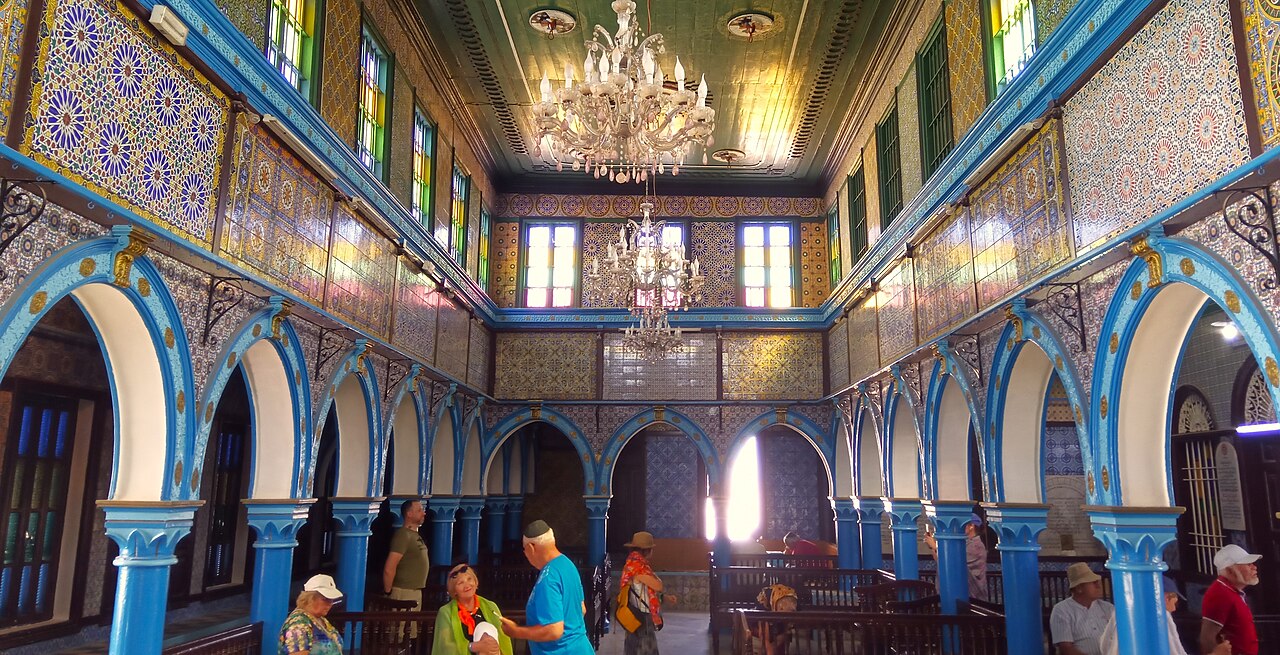
Plus ancienne synagogue d'Afrique du Nord selon la tradition. Reliquaire d'une porte du Premier Temple de Jérusalem (586 av. J.-C.). Pèlerinage annuel à Lag Ba'omer attire des milliers de pèlerins juifs du monde entier. Architecture intérieure éblouissante : carreaux de céramique persane bleus, lustres, manuscrits sacrés (la « Ghriba » = « la solitaire » en arabe). Lieu de coexistence et tolérance interreligieuse.
⛪ Lieu de culte chrétien (1)
L'église Saint-Joseph est le seul lieu de culte chrétien inscrit, témoignage de la présence européenne (italienne, maltaise, française) durant la période moderne et coloniale.
Église Saint-Joseph — Houmt Souk (1848)
Église catholique construite par les missionnaires français au XIXe siècle pour la communauté chrétienne de Djerba (commerçants italiens et maltais, fonctionnaires français). Architecture néo-baroque sobre. Toujours en activité, célèbre la messe pour les quelques chrétiens européens résidents et les touristes.
🏛️ Architecture civile et habitat (5)
Les bâtiments civils inscrits illustrent l'organisation spatiale traditionnelle djerbienne : médina ottomane, fondouks (caravansérails), maisons fortifiées (houch), résidences nobles (menzel).
Médina de Houmt Souk — Houmt Souk (IXe - XVIIIe siècles)
Centre historique de l'île. Souks couverts spécialisés (bijoutiers, tisserands, épiciers, parfumeurs), fondouks ottomans (XVIIe-XVIIIe siècles) transformés en hôtels de charme. Cœur commercial, religieux et politique de Djerba pendant 1000 ans.
Borj El Ghazi Mustapha — Houmt Souk (port) (1289 / agrandissements XVIe siècle)
Forteresse côtière construite en 1289 par l'amiral aragonais Roger de Lluria, agrandie par les Espagnols (1535) et les Ottomans (à partir de 1574). Théâtre du sinistre massacre de Dragut en 1560 (5 000 chrétiens tués). Plan triangulaire à bastions, casemates, citernes.
Houch traditionnel (ferme fortifiée) — Toute l'île (plusieurs exemples) (XVIIe - XIXe siècles)
Type architectural unique au monde : ferme fortifiée carrée à patio central, dotée de tours d'angle, citernes, cour, palmiers, étables. Le houch (« cour » en dialectal djerbien) accueillait une famille élargie sous l'autorité du patriarche. Plusieurs centaines de houch préservés sur l'île.
Menzel (résidence noble) — Plusieurs villages (XVIIIe - XIXe siècles)
Résidence aristocratique djerbienne, plus élaborée que le houch. Patio à colonnes, mokhtars (salons décorés), terrasses, jardins. Réservé aux familles nobles et marchands prospères de l'île.
Fondouks ottomans — Médina de Houmt Souk (XVIIe siècle)
Caravansérails ottomans : Fondouk El Bakri, Fondouk El Berrada, Fondouk El Erbi. Bâtiments à 2 étages organisés autour d'un patio central avec galerie. Au rez-de-chaussée : entrepôts et écuries. À l'étage : chambres pour les marchands. Aujourd'hui transformés en hôtels de charme.
🌊 Système hydraulique et agraire (2)
Le système d'irrigation djerbien millénaire est une prouesse technique étudiée comme modèle d'agriculture durable en zone aride.
Système hydraulique traditionnel — Toute l'île (VIIe - XXe siècle)
Réseau ingénieux combinant : majen (citernes enterrées), foggara (galeries souterraines drainant la nappe phréatique), saqia (canaux d'irrigation), khettara (puits à roue). Permet de cultiver oliviers, palmiers et légumes en milieu aride. 7 000 majen recensés sur l'île, dont les plus anciens datent du Xe siècle.
Palmeraie et oliveraie traditionnelle — Centre et sud de l'île (Antiquité - présent)
Système agraire étagé : palmiers (étage haut, dattes), oliviers et arbres fruitiers (étage moyen), cultures maraîchères (étage bas). 1,2 million d'oliviers (dont certains millénaires), 200 000 palmiers. Production d'huile d'olive djerbienne réputée.
Critères de l'inscription UNESCO
Critères retenus
- L
- '
- i
- n
- s
- c
- r
- i
- p
- t
- i
- o
- n
- U
- N
- E
- S
- C
- O
- 2
- 0
- 2
- 3
- r
- e
- p
- o
- s
- e
- s
- u
- r
- l
- e
- c
- r
- i
- t
- è
- r
- e
- (
- v
- )
- :
- «
- o
- f
- f
- r
- i
- r
- u
- n
- e
- x
- e
- m
- p
- l
- e
- é
- m
- i
- n
- e
- n
- t
- d
- '
- é
- t
- a
- b
- l
- i
- s
- s
- e
- m
- e
- n
- t
- h
- u
- m
- a
- i
- n
- t
- r
- a
- d
- i
- t
- i
- o
- n
- n
- e
- l
- o
- u
- d
- '
- u
- t
- i
- l
- i
- s
- a
- t
- i
- o
- n
- t
- r
- a
- d
- i
- t
- i
- o
- n
- n
- e
- l
- l
- e
- d
- u
- t
- e
- r
- r
- i
- t
- o
- i
- r
- e
- o
- u
- d
- e
- l
- a
- m
- e
- r
- ,
- q
- u
- i
- s
- o
- i
- t
- r
- e
- p
- r
- é
- s
- e
- n
- t
- a
- t
- i
- f
- d
- '
- u
- n
- e
- c
- u
- l
- t
- u
- r
- e
- (
- o
- u
- d
- e
- c
- u
- l
- t
- u
- r
- e
- s
- )
- »
- .
- D
- j
- e
- r
- b
- a
- i
- l
- l
- u
- s
- t
- r
- e
- l
- '
- a
- d
- a
- p
- t
- a
- t
- i
- o
- n
- h
- a
- r
- m
- o
- n
- i
- e
- u
- s
- e
- d
- '
- u
- n
- e
- s
- o
- c
- i
- é
- t
- é
- a
- u
- x
- c
- o
- n
- t
- r
- a
- i
- n
- t
- e
- s
- d
- '
- u
- n
- m
- i
- l
- i
- e
- u
- i
- n
- s
- u
- l
- a
- i
- r
- e
- a
- r
- i
- d
- e
- p
- a
- r
- u
- n
- s
- y
- s
- t
- è
- m
- e
- a
- r
- c
- h
- i
- t
- e
- c
- t
- u
- r
- a
- l
- ,
- h
- y
- d
- r
- a
- u
- l
- i
- q
- u
- e
- e
- t
- s
- o
- c
- i
- a
- l
- c
- o
- h
- é
- r
- e
- n
- t
- ,
- m
- a
- r
- q
- u
- é
- p
- a
- r
- l
- a
- c
- o
- e
- x
- i
- s
- t
- e
- n
- c
- e
- p
- a
- c
- i
- f
- i
- q
- u
- e
- d
- e
- t
- r
- o
- i
- s
- c
- o
- m
- m
- u
- n
- a
- u
- t
- é
- s
- r
- e
- l
- i
- g
- i
- e
- u
- s
- e
- s
- (
- m
- u
- s
- u
- l
- m
- a
- n
- e
- i
- b
- a
- d
- i
- t
- e
- ,
- j
- u
- i
- v
- e
- e
- t
- c
- h
- r
- é
- t
- i
- e
- n
- n
- e
- )
- p
- e
- n
- d
- a
- n
- t
- 2
- 6
- 0
- 0
- a
- n
- s
- .
Trois communautés religieuses, 2600 ans de coexistence
3 millénaires de cohabitation pacifiqueDjerba est l'un des rares lieux au monde où coexistent depuis 2600 ans trois communautés religieuses : musulmans (majoritairement ibadites), juifs et chrétiens (autrefois). Cette tolérance interreligieuse est le pilier de l'identité djerbienne et un argument majeur de l'inscription UNESCO 2023.
Musulmans ibadites
Depuis : VIIIe siècle · Membres actuels : 150 000 (majorité de l'île)
Branche minoritaire de l'islam (kharidjisme modéré). Doctrine puritaine et égalitaire. Plus de 200 mosquées sur l'île. Architecture vernaculaire unique : mosquées-forteresses sans décoration, blanchies à la chaux. Grandes communautés ibadites au monde : Djerba, Mzab algérien, Oman.
Communauté juive
Depuis : 586 av. J.-C. (tradition) · Membres actuels : Environ 1 000 (étaient 7 000 au XIXe siècle)
Plus ancienne communauté juive d'Afrique du Nord. Synagogue de la Ghriba à Hara Seghira. Yeshivot historiques. Pèlerinage annuel à Lag Ba'omer. Spécialités gastronomiques (couscous bel hout, brik à l'œuf). Émigration massive vers Israël après 1948 (réduction de 7000 à 1000).
Chrétiens (historique)
Depuis : IIIe siècle apr. J.-C. · Membres actuels : Quelques dizaines (résiduels)
Communauté chrétienne importante à l'époque romaine et byzantine (basiliques de Henchir el-Hattaya). Évêques aux conciles de Carthage. Quasi-disparition après la conquête arabe. Aujourd'hui, quelques chrétiens européens résidents.