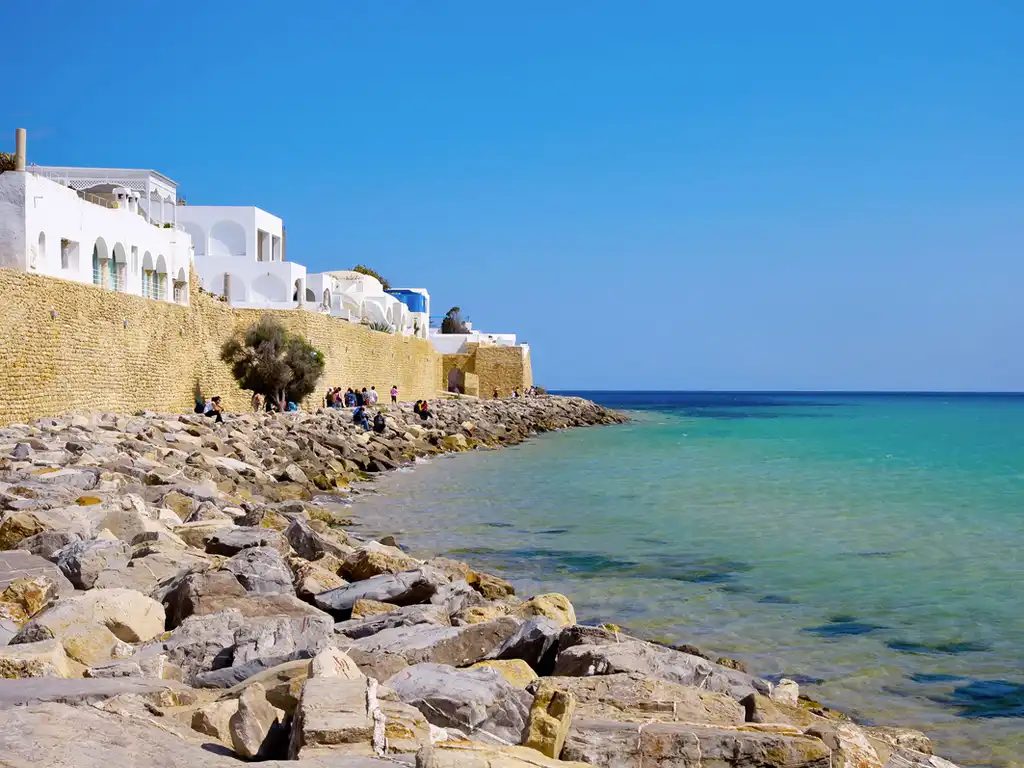
Hammamet Medina
Historic whitewashed heart of the 13th century, surrounded by ramparts. Flower-lined alleyways, craft shops, mosque, hammams. Smaller and more intimate than Tunis or Sousse, perfect for wandering.
Flagship seaside resort on Cap Bon (north-east coast), Hammamet combines 14 km of golden sandy beaches, an ancestral 13th-century medina and refined Andalusian architecture.
Flagship seaside resort on Cap Bon (north-east coast), Hammamet combines 14 km of golden sandy beaches, an ancestral 13th-century medina and refined Andalusian architecture. George Bernard Shaw wrote back in 1928: "This is what I believe to be paradise." From its kasbah overlooking the port to the gardens of Yasmine Hammamet, passing through the neighbouring artisan villages of Nabeul, the region offers a concentrated taste of the Tunisian art of living.
The site has been inhabited since Antiquity. The Romans established the city of Pupput (Pudpud) here, an important rural centre on the Roman road between Carthage and Hadrumetum (Sousse). Archaeological remains now visible 5 km to the north (mosaics, thermal baths, Early Christian basilicas). In the 9th century, the Aghlabites fortified the coast against Byzantine incursions: Hammamet ("baths" in Arabic) is mentioned for the first time.
In the 13th century, under the Hafsids, the city takes on its present appearance: the Kasbah is built (1463), the medina fortified by 6 gates, the Great Mosque erected. The Barbary corsairs make it an advanced base from the 16th to 18th centuries. Under the Ottomans, Hammamet remains a small trading port. In the 19th century, the city opens up to Europeans: Romanian millionaire George Sebastian builds the Sebastian Villa here in 1920, prototype of modern architectural tourism.
Seaside tourism takes off after independence (1956) with the development of the northern hotel zone (1960). Hammamet becomes the country's leading resort. Yasmine Hammamet, a modern integrated resort with marina, reconstructed medina and Carthageland park, is inaugurated in 1995. Today, the agglomeration welcomes over 1.5 million tourists per year, mainly European. The municipality has recently launched a plan to preserve heritage and the environment (protected areas on Cap Bon).
8 Must-See Sites Selected by Our Local Team.
Historic whitewashed heart of the 13th century, surrounded by ramparts. Flower-lined alleyways, craft shops, mosque, hammams. Smaller and more intimate than Tunis or Sousse, perfect for wandering.
15th-century fortress (1463) overlooking the port and medina. Renovated by the Spanish then the Ottomans. Panoramic view of the bay. Small interior museum.
Modern integrated resort (1995) 8 km to the south. Marina with 740 berths, reconstructed medina (souks, mosque, restaurants), Carthageland park (historic rides), casino, 5-star hotels.
14 km of golden fine sand between central Hammamet and Yasmine. Shallow and calm waters (protected bay). Water sports centres (jet-ski, parasailing, banana boat), beachfront restaurants.
Roman archaeological site 5 km north. Exceptional mosaics, early Christian basilicas (5th century), necropolis, thermal baths.
Modernist villa built in 1920 by George Sebastian, Romanian millionaire. Frank Lloyd Wright called it "the most beautiful villa I know". Park, ancient theatre, host of the Hammamet International Festival.
12 km north-east. Tunisia's capital of pottery and lace. Friday market (most lively in the Cap Bon: artisans, fruit, livestock). Neapolis (Punic remains).
Unique Punic site in the world, never reconquered by Rome after 146 BC. Urban layout, clay bathtubs, exceptionally preserved coloured paving. 60 km north-east, Cap Bon.
A journey through the epochs that shaped Hammamet.
Fortress built to protect the coast from Christian raids. Rectangular layout, 4 corner towers, cistern, armoury. Reorganised by the Spanish (1535) then the Ottomans (1574). Today, exceptional panoramic views over the bay.
Hafsid fortified wall protecting the original city. Six monumental gates (Bab Souk, Bab El Bhar, Bab El Souika...), sentry walks, corner towers. The layout has remained unchanged for 700 years.
Roman provincial city on the road from Carthage to Hadrumetum. Mosaics of Annus (allegory of the seasons), 5th century early Christian basilica, necropolis with marble sarcophagi. Testimony to the Christianisation of the province.
Moorish modernist architecture built by Romanian millionaire George Sebastian. Lounges, library, cruciform swimming pool, Andalusian gardens, reconstructed ancient theatre (1933). Host of the Hammamet International Festival since 1964.
Unique Punic city in the world: abandoned in 146 BC after the fall of Carthage and never rebuilt, its urbanism and Punic domestic architecture are perfectly preserved. UNESCO 1985 and 1986. Discovered in 1952.
Tunisia's oldest living arts festival (since 1964) at the ancient theatre of Villa Sebastian. Theatre, world music, contemporary dance. Prestigious international programme.
Celebration of the orange and clementine harvest from Cap Bon. Flower-adorned floats, tastings, popular concerts.
Private car: 5h30 via motorway A1 (490 km). SNTRI bus: 7h, 35 DT. Tunis Carthage flight + 1h taxi transfer: convenient but not faster. Recommended: private car to combine stops or 2-day excursion.
Local buses between Hammamet and Yasmine (1 DT). Taxis plentiful and cheap. Tourist horse-drawn carriages between Medina and port. Electric bike hire on the corniche.
Hammamet for calm and chic vibes, more turquoise waters. Sousse for liveliness and culture-beach mix. Yasmine Hammamet beaches rank among Tunisia's finest. Sousse-Boujaâfar livelier but more crowded.
Very family-friendly. Shallow and calm waters, hotels with kids' clubs, parks (Carthageland, Friguia Park), secure medina, entertainment. Ideal with children aged 3–12.
Moderate. Bars and clubs concentrated in Yasmine Hammamet (Calypso, Manhattan). Medina closes early. Casino in Yasmine Hammamet open until 4am.
Thalasso spa (Hasdrubal, Mövenpick), traditional hammam, arcade-covered medina, Pupput museum, Carthageland (partially covered), Villa Sebastian, Yasmine shopping.
Tunis–Carthage–Sidi Bou Saïd (1h, full day). Cap Bon: UNESCO Kerkouane + Kélibia + Korbous (full day). Sahara from Hammamet (2 days, Douz, Tozeur, Star Wars). Friguia Park (wildlife park, half day for children).
Our local team designs your ideal Hammamet programme. Private car or group spot, market's most competitive prices.